Wayne State University-College of Education
Lesson Plan Format
Teacher: Lada
Date: 11/18/2024
Setting: Elementary Classroom
Grade Level: Second Grade
Topic/Unit: Color Theory
Lesson Title: Primary Colors
Core Subject: ELA
Integration:
-
SMART GOAL
-
Students will be able to identify listed colors
-
Students will be assessed on a coloring worksheet
-
Color words will be added to this week’s spelling words
-
Students should be able to complete worksheet in 15-20 minutes
-
Learning Primary and Secondary colors in the first step in learning the color wheel
Vocabulary:
Color
Primary Color
-
Red
-
Blue
-
Yellow
Secondary Color
-
Purple
-
Green
-
Orange
Enduring Understandings/ Essential Questions
-
Why is color important?
-
Nature
-
Beauty
-
Survival
-
Cross Curriculum
-
ELA –Color words will be on spelling test
-
ART.VA.I.2.3 Compare and explore elements of art and principles of design to communicate ideas related to personal environment.
-
ART.VA.III.2.1 Develop and visual vocabulary.
-
ART.VA.V.2.1 Describe how art is used in everyday life.
-
Learning Resources and Materials
Teacher materials:
-
Book
-
Pre-Colored Worksheet
-
Clipboard
Student materials:
-
Crayons
-
Red, Yellow, Blue, Green, Purple, Orange
-
-
Worksheet
-
Development of Lesson
Pre-Teaching activities-Classroom modification:
-
Baskets with crayons will be placed in the center of the tables
-
Worksheets will be passed out after book reading
Introduction
-
Read the book “Splatter”
-
Today we are going to learn about Primary and Secondary Colors.
-
There are 3 Primary colors and 3 Secondary colors. The secondary colors are created by combining the Primary colors.
-
And, now you are going to practice identifying and labeling the primary and secondary colors on a worksheet.
Methods/Procedures
-
To pre-asses the classroom, I will begin by asking the students to raise their hands if they know what a primary color is.
-
I will then call on students to name the 3 primary colors, while repeating them and listing them with my fingers. (1- blue, 2- red, 3- yellow)
-
I will read the book “Splatter” to the class.
-
We will briefly talk about the book, answer any questions.
-
I will pass out the worksheets
-
I will instruct the class with the first two rows of the worksheet. (I do)
-
The third row I will ask the class what they think the colors should be and we will work together. (We do)
-
The fourth row, I will let the students work independently and choose the colors. (You do)
-
Students will have about 2 minutes to put crayons back into the baskets and put worksheets in their cubbies.
Student Work Period-
-
Students will complete the fourth row of the worksheet independently.
-
I will walk around the classroom observing students work and individually help when needed
Accommodations/Adaptations
-
Students will be sitting in assigned seats.
-
Students will be able to communicate with each other.
-
Students will have access to adaptive materials.
-
Large Crayons
-
Para pro
-
-
I will walk students through the worksheet. (I do, we do, you do)
Assessment/Evaluation
-
Worksheet
-
Students will be able to identify primary colors.
-
Students will be able to identify secondary colors.
-
Students will be able to name the primary colors that combine to make the secondary colors.
-
-
Exit ticket
-
Closure
-
Shortly before students begin cleaning up, I will point out objects in the room and ask if the object is a primary or a secondary color.
-
I will alert the class when it is time to clean up 2-5 minutes
-
Students will place crayons back in the baskets and turn in worksheets to their take-home cubbies.
-
After clean-up student will complete an exit ticket
-
Teacher Reflection
What went well?
-
____________________________________________________
-
____________________________________________________
-
____________________________________________________
What needs modifying?
-
____________________________________________________
-
____________________________________________________
-
____________________________________________________
What would I do next?
-
____________________________________________________
-
____________________________________________________
-
____________________________________________________
-
Rubric
Developing
Emerging
Proficient
Identifying Colors
(Red, Blue, Yellow, Green, Orange, Purple)
Student can properly identify 0-2 colors
Student can properly identify 3-5 colors
Student can properly identify 6 colors
Identifying Primary Colors
(Red, Blue, Yellow)
Student cannot properly identify any primary colors
Student can properly identify 1-2 primary colors
Student can properly identify 3 primary colors
Identifying Secondary Colors
(Green, Orange, Purple)
Student cannot properly identify any secondary colors
Student can properly identify 1-2 secondary colors
Student can properly identify 3 secondary colors
Color Mixing
Student cannot identify the primary colors that combine to make the secondary colors
Student can identify the primary colors that combine to make 1-2 of the secondary colors
Student can identify the primary colors that combine to make the 3 secondary colors


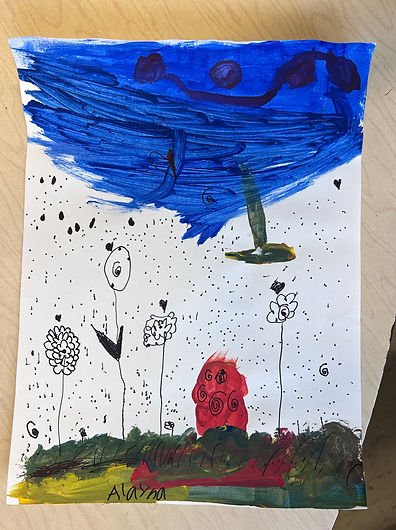
Student Examples